Last Rites · Sick calls
Extreme Unction & Sick Calls
At any hour. After office hours (4:30 p.m. to 9:00 a.m.), choose option 9 and follow the prompts.
Please don’t wait until the last moment. Call while the sick person can still pray with the priest.
Two kinds of sick calls
Urgent
A sacramental emergency
When someone is in danger of death from illness, has suddenly become seriously ill, or is close to death, call a priest at once, day or night, using the emergency number above. After office hours, choose option 9.
The priest brings the Last Rites: Confession, Holy Communion as Viaticum, and Extreme Unction.
Ordinary
Visits to the sick and homebound
If you or someone in your family is ill, recovering, or unable to come to Mass, and would like a priest to visit, hear a confession or bring Holy Communion, please speak with a priest after Mass or contact the office to arrange a visit.
A holy death
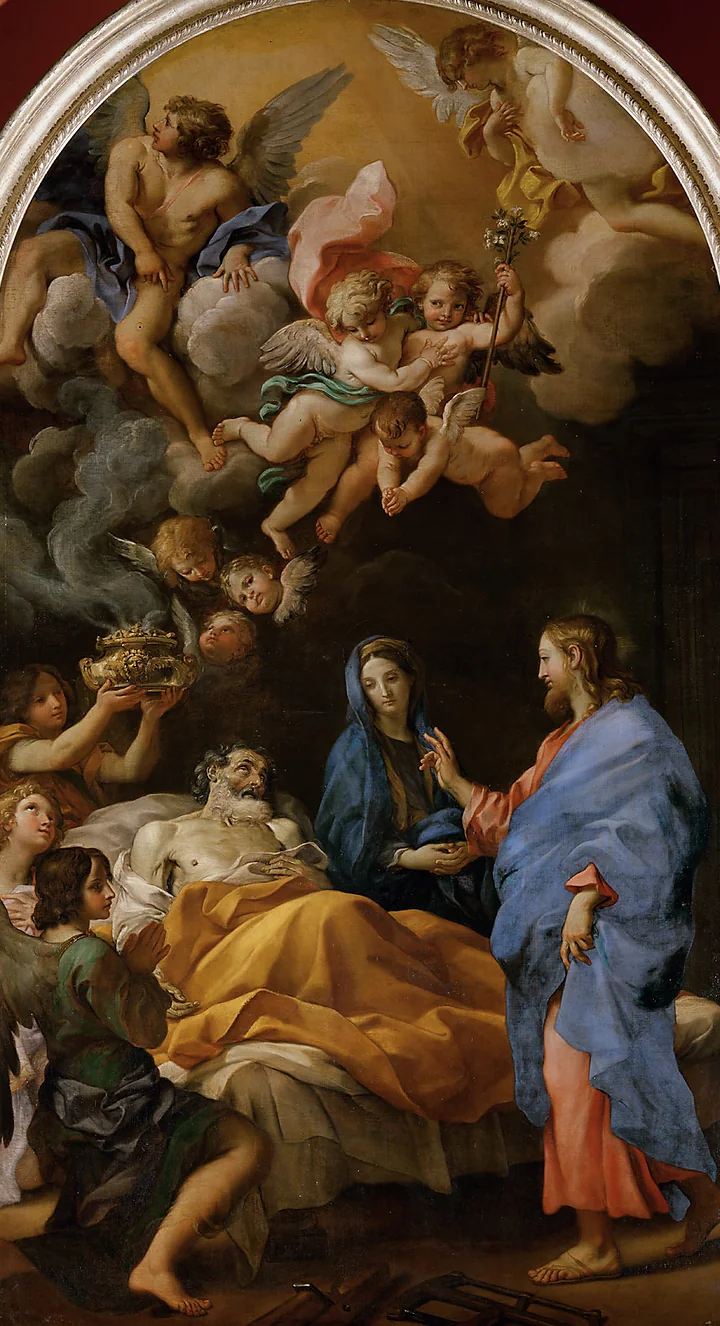
Tradition honors St. Joseph as the patron of a happy death, for he died in the arms of Jesus and Mary. Maratta painted this altarpiece for the chapel of the Dowager Empress Eleonora in the imperial palace at Vienna: Christ blesses His foster father, Our Lady keeps watch, and Heaven bends down to receive him.
“Precious in the sight of the Lord is the death of his saints.”
This is the grace the Church wants for every soul: to meet death prepared, absolved and anointed, trusting in the mercy of God.
What the Church teaches
“Is any man sick among you? Let him bring in the priests of the church, and let them pray over him, anointing him with oil in the name of the Lord. And the prayer of faith shall save the sick man: and the Lord shall raise him up: and if he be in sins, they shall be forgiven him.”
Its effects
The Council of Trent teaches that the grace of this sacrament “cleanses away sins, if there be any still to be expiated, as also the remains of sins; and raises up and strengthens the soul of the sick person, by exciting in him a great confidence in the divine mercy.” It helps the sick to bear their pains, to resist the last temptations, “and at times obtains bodily health, when expedient for the welfare of the soul.”
Council of Trent, Session XIV (1551), On Extreme Unction, ch. II
Do not delay
The sacrament is for those whose illness brings a real danger of death. Its graces are received most fully while the sick person can still pray with the priest. The Roman Catechism is plain: “It is, however, a very grievous sin to defer the Holy Unction until, all hope of recovery being lost, life begins to ebb, and the sick person is fast verging into a state of insensibility.”
Roman Catechism, Part II, Extreme Unction
Preparing for the priest’s visit
When the priest brings the Blessed Sacrament, Our Lord Himself enters the home. If there is time, the SSPX suggests preparing:
- A small table near the bed, where the sick person can see it, covered with a clean white cloth.
- A standing crucifix between two blessed candles, lit.
- Holy water, and a glass of ordinary water for the priest’s fingers.
- For Extreme Unction, a few pieces of cotton on a small plate.
Meet the priest at the door in silence, with a lit candle if you can, and lead him to the sick person. Kneel and pray with him; everyone steps out only for the confession. In an emergency, simply call; you do not need to have anything ready.
From SSPX Great Britain, “Visitation of the sick” (opens in a new tab) and SSPX Australia, “Sick calls” (PDF) (opens in a new tab). See also SSPX USA, “Extreme Unction: Last Rites of the Church” (opens in a new tab).
When a loved one dies
Please let the priory know as soon as you can, using the number at the top of this page. After office hours (4:30 p.m. to 9:00 a.m.), choose option 9 and follow the prompts. You may also ask for Masses to be offered for the deceased.
Asking for a priest
For a visit to the sick or Holy Communion at home, please speak with a priest after Mass or contact the office. In danger of death, call at once, day or night.